There’s something immediately calming about a Modern Organic interior. Clean lines and uncluttered spaces give the eye room to rest, while warm woods, tactile fabrics, earthy colors, and imperfect natural textures keep the room from feeling cold or overly polished.
It may look effortless, but Modern Organic design is really a careful balancing act: modern structure softened by nature.
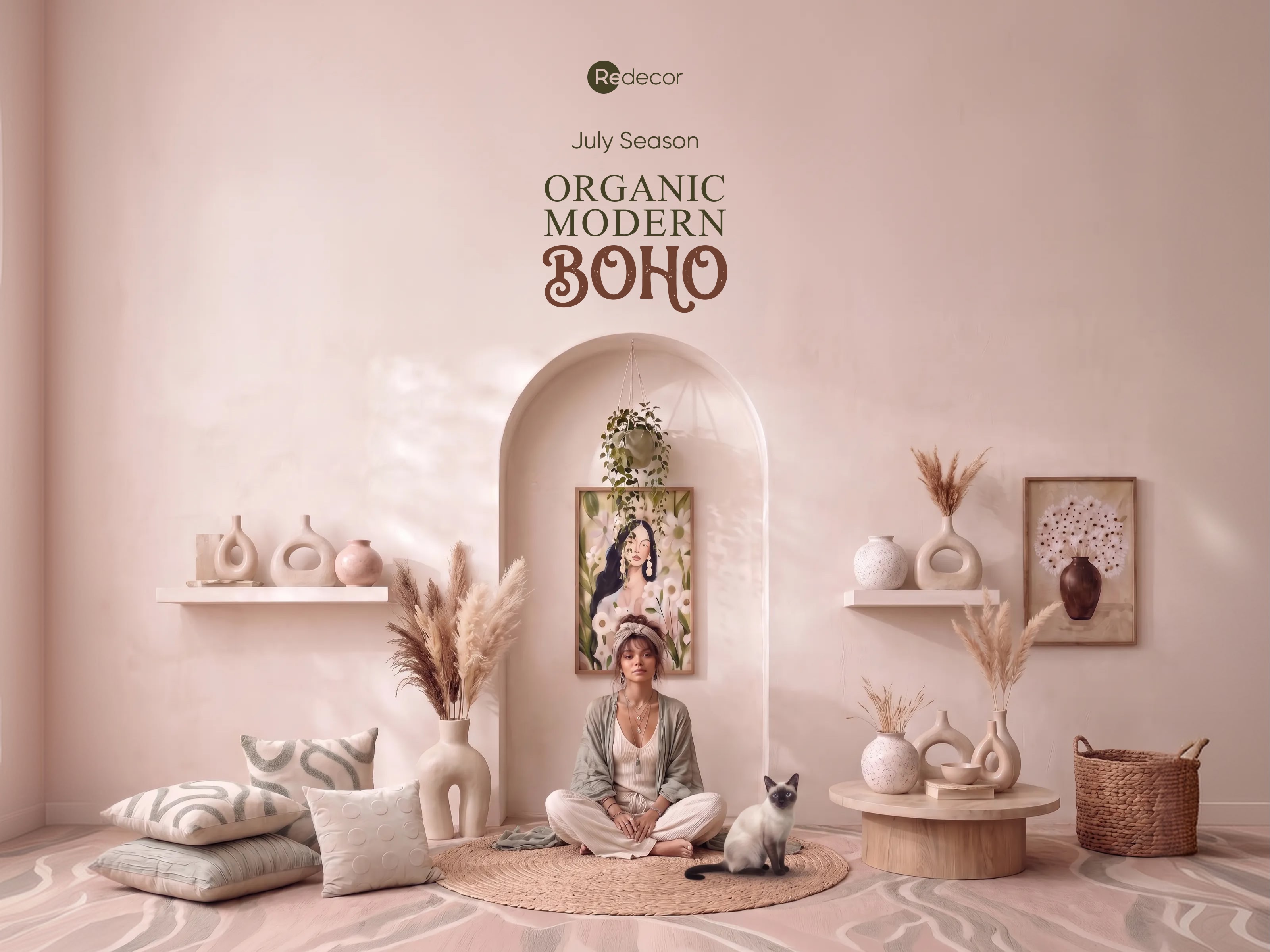
This season, we’re exploring that balance with a touch of Bohemian spirit. While Modern Organic and Boho are distinct design styles with different histories, they share an appreciation for natural materials, texture, craftsmanship, and interiors that feel warm rather than overly formal. Together, they create spaces that are relaxed, contemporary, and full of character.
But where did Modern Organic design actually come from?
The Roots of Modern Organic Design
Modern Organic isn’t tied to one historical movement or designer. Instead, it grew from several influential ideas in 20th-century design — particularly the belief that modern homes didn’t have to choose between innovation and nature.
One important influence was Organic Architecture, a philosophy closely associated with American architect Frank Lloyd Wright. Wright believed buildings should exist in harmony with their surroundings, rather than feeling imposed upon them. Natural materials, strong connections between indoors and outdoors, and designs influenced by the landscape became important parts of this philosophy.
At the same time, Modernism was transforming architecture and interiors. Designers embraced simpler forms, functionality, and the rejection of excessive ornamentation. The clean geometry we now associate with modern interiors owes much to these early Modernist ideas.
Mid-century designers continued exploring how these principles could coexist with warmth and nature. Wood, leather, woven materials, stone, and sculptural forms frequently appeared alongside the clean lines of modern design.
Later, Scandinavian design helped popularize another important idea: simplicity could feel warm and welcoming. Pale woods, natural materials, functional forms, and comfortable textiles offered a softer interpretation of modern living.
Contemporary Modern Organic interiors bring many of these ideas together. The architecture and composition remain relatively restrained, but natural materials, irregular textures, earthy colors, and softer shapes prevent the space from feeling stark.
The result is less about following a strict historical rulebook and more about achieving harmony between simplicity and nature.
So, Where Does Boho Fit In?
Bohemian design has a different story.
The term “bohemian” became associated with unconventional artistic lifestyles in 19th-century Europe and, over time, evolved into an interior aesthetic known for eclectic combinations, global influences, handmade objects, pattern, color, and collected-over-time character.
Traditional Boho interiors can be considerably more layered and decorative than Modern Organic spaces. But contemporary interpretations of Boho — particularly the quieter, earthier side of the style — overlap beautifully with Modern Organic design.
Both can celebrate woven fibers, warm woods, handmade-looking surfaces, botanical inspiration, tactile fabrics, and natural imperfection.
The key is restraint.
Rather than filling every surface with Bohemian decoration, Modern Organic Boho borrows its warmth and personality. Think of Modern Organic as the foundation and Boho as an expressive layer: a woven pattern here, an earthy artwork there, or a more playful combination of textures.
How to Create the Modern Organic Look in Redecor
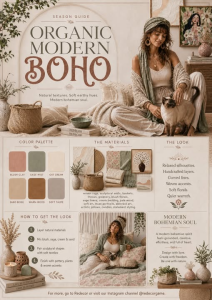
You don’t need to change the architecture of a room or fill it with specific decorative objects to capture this style. In fact, some of its most important characteristics can be expressed through exactly the choices you make in Redecor: color, material, texture, pattern, and art.
Here are five principles to keep in mind.
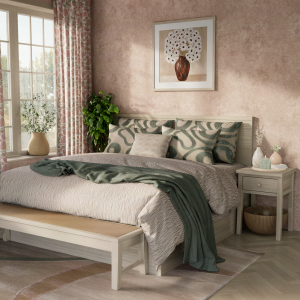
1. Build an Earthy, Layered Neutral Palette
Modern Organic interiors are often associated with neutrals, but that doesn’t mean everything needs to be beige.
Look toward nature for your palette: warm white, sand, oatmeal, clay, mushroom, taupe, caramel, muted brown, olive, terracotta, and soft mineral tones all feel at home here.
Instead of using one neutral everywhere, layer several related shades. A warm cream wall might sit beside medium-toned wood, sandy upholstery, and a deeper brown accent.
For the Modern Organic Boho twist, introduce restrained earthy colors such as rust, ochre, dusty green, or sun-faded terracotta.
Redecor Tip: Before submitting, look at your room as a complete palette. If one color feels dramatically brighter, cooler, or more saturated than everything around it, consider replacing it with a softer, earth-derived alternative.
2. Let Texture Do the Decorating
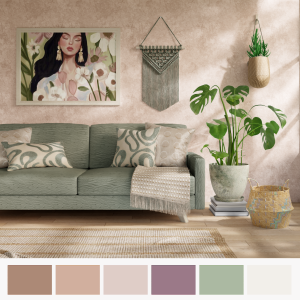
In Modern Organic design, visual interest often comes from texture rather than ornament.
Imagine the contrast between rough stone and smooth wood, loosely woven linen and matte plaster, or natural fibers and subtly grained surfaces. Even when the colors are similar, differences in texture keep the room interesting.
This is especially useful in Redecor because texture can communicate the style even when you can’t change the objects within a scene.
Choose materials that look tactile: visible wood grain, woven fabrics, linen-like textiles, stone, plaster, ceramics, rattan-inspired surfaces, and subtly irregular finishes.
Redecor Tip: If your design is mostly neutral, don’t ask, “Where can I add more color?” Ask, “Where can I add a different texture?” A room can be almost entirely cream and brown and still feel richly layered when its surfaces are varied.
3. Choose Nature-Inspired Art — Without Making It Too Literal
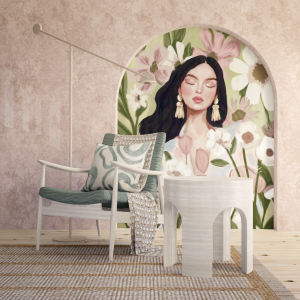
Artwork offers another opportunity to reinforce the connection with nature.
Botanical subjects, landscapes, abstract organic shapes, earthy compositions, and artwork inspired by natural forms can all complement the style. But you don’t necessarily need a picture of a leaf to make a room feel organic.
Look for shape and movement too. Curving lines, irregular forms, soft edges, and compositions that resemble landscapes or natural patterns can introduce an organic feeling without becoming overly thematic.
Boho influences can come through particularly well here. Handmade-looking illustrations, folk-inspired graphics, abstract suns, earthy geometrics, and relaxed artistic compositions can add personality to an otherwise restrained room.
Redecor Tip: Treat art as part of your color palette. Choose pieces that repeat or gently expand upon colors already present in the room rather than introducing several completely unrelated shades.
4. Balance Clean and Imperfect
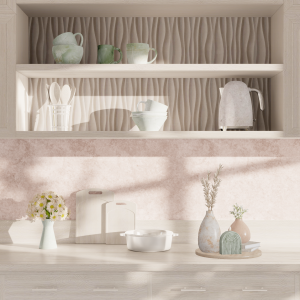
One of the secrets to Modern Organic design is contrast.
Modernism brings order, simplicity, and cleaner lines. Nature brings variation, irregularity, and imperfection.
Too much sleekness and the room can begin to feel clinical. Too much rustic texture, pattern, and decoration and you may move away from Modern Organic toward Rustic or traditional Boho.
Try pairing opposites instead.
A clean surface can sit beside heavily grained wood. A simple neutral textile can balance an irregular woven pattern. Smooth stone can contrast with a fabric that visibly shows its weave.
The goal isn’t to make every material organic-looking. It’s to allow natural textures to soften the modern ones.
Redecor Tip: Use the room’s existing architecture as your guide. If the scene already contains strong modern lines, you can afford to be more expressive with natural textures. If the architecture is already rustic or highly detailed, keep your material and pattern choices quieter.
5. Layer Boho Carefully
This is where our seasonal interpretation comes into play.
Boho can bring warmth and individuality to Modern Organic design, but moderation keeps the overall look contemporary.
Instead of combining many bold patterns, choose one or two moments of pattern and surround them with quieter materials. Look for motifs with an artisanal feeling, softened geometry, subtle botanical references, or earthy colors.
Scale matters too. A detailed Boho-inspired pattern becomes much easier to balance when neighboring surfaces are simple.
Think of it as a hierarchy:
Modern simplicity sets the structure.
Organic materials create warmth.
Boho details add personality.
If all three compete equally for attention, the room can become visually busy. When they work in that order, the result feels much more intentional.
Redecor Tip: After finishing your design, identify the three most visually noticeable surfaces. If all three feature strong patterns, colors, or textures, simplify at least one. Giving the eye somewhere to rest is just as important as giving it something beautiful to discover.
The Beauty of Balance
Modern Organic design reflects an idea that has appeared repeatedly throughout design history: modern living doesn’t have to mean leaving nature behind.
Its clean lines connect it to Modernist traditions. Its warmth owes much to generations of designers who explored wood, stone, natural fibers, craftsmanship, and the relationship between interiors and their surroundings. And when a little Bohemian influence enters the mix, the style gains another layer of artistry and individuality.
The trick is not to recreate nature literally — it’s to borrow its palette, textures, irregularities, and sense of harmony.
So, as you design your Modern Organic Boho spaces this season, remember: keep the foundation simple, let natural textures speak, layer your neutrals, and add personality with intention.
Sometimes, the most inviting rooms aren’t the ones with the most decoration. They’re the ones where every material feels like it belongs.
Ready to raise a cat this month?
Cats are famously free-spirited, making them the perfect companions for our Bohemian season! Throughout August, look out for 10 Designs featuring the “Raise a Cat” LiveTag. Complete any 7 of them to receive Bobo, your very own Limited Item Redecor cat!
Joining the journey late? Don’t worry—on August 26, all 10 Designs will return, giving you another chance to catch up.
Let’s follow Bobo’s lead, embrace our free-spirited side, and enjoy a wonderful season together!